Showing posts with label English tea party. Show all posts

Wednesday, November 16, 2011

Bush Tea and Boiled Pumpkin

My dad recommended a book to me about a year ago.  He said it was about woman in Botswana who runs a private detective agency.  That was enough to get me hooked.

The No. 1 Ladies Detective Agency, by Alexander McCall Smith, is the first in a 12 book series (and still going - #12 came out this year) that has been highly successful.  It has entertaining characters, and is a wonderful slice of life in Botswana.  It’s unique and human, strange and yet so relatable.  It’s the sort of book you can set down for a year and pick up in the middle and immediately enjoy again.  I think the best word to describe it is “charming.”

Plus I liked it because it was written by a Brit (Scotsman, to be specific).  What can I say?  I love all things British.

The cool thing about the series is that it tells so much about African life.  I knew nothing about Botswana before I started reading, and now I know lots about their traditions and attitudes and the food they eat.

That’s right.  It all comes back to the food.

If you have read any of the Precious Ramotswe (the main character in the series) books, you can probably guess what two foods I tried.

1)      Bush Tea
2)      Pumpkin


McCall Smith constantly talks about bush tea throughout the series, because it’s pretty much Mma Ramotswe’s favorite thing in the world.  I always thought it was entertaining, because it combined the very British ideals of constantly drinking tea with the African plant, which comes from the Bush.  And by Bush I don’t mean a shrubbery.

Or the U.S. president.
I mean the wilderness.  Specifically the hot, dry desert of southern Africa where only the Bushmen live.

 If you haven’t seen this movie (The Gods Must Be Crazy), go watch it right now!  Slapstick/cultural clash comedy at its finest.

I assumed I wouldn’t be able to try bush tea, because I don’t drink tea unless it’s herbal tea for religious reasons.  (If you want to know about the Word of Wisdom and why Mormon’s don’t drink tea, click here.)  But it turns out that bush tea is an herbal tea!  That means it’s 100% natural, caffeine free, and therefore not habit-forming/addictive.  So I got to try it!

Bush Tea, otherwise known as Rooibos or Red Bush Tea is a tea made from the rooibos plant, which grows in southern Africa.  The tea is red in color and has a very mild flavor which children tend to like.  It’s also good for settling stomachs and (supposedly) relieving allergies.  

I admit that I don’t usually care for herbal tea unless it’s drowned in sugar and milk/cream.  To me it always tastes like someone plucked some grass or weeds off their lawn and stuck it in a cup of hot water. 

 
I’d rather drink plain water 95% of the time.  However, I really wanted to try bush tea since it’s such a huge part of the No. 1 Ladies’ Detective Agency books.  So I went to the nearest organic health foods store and bought the cheapest box I could find (it was sold under “Rooibos tea”).  If you want to learn more about preparing tea, check out Julie's post about it from our English Tea Party.


I can honestly say, as one who is normally biased against herbal teas, that I actually liked bush tea! 

 It was very mild in flavor, and definitely a little earthy (what tea isn’t?), but it didn’t taste watery either.  And I normally don’t buy into the whole “tea calms you/settles your stomach” thing, but this stuff had a strange relaxing quality to it.  I’ll have to try it when my stomach feels a little off.

I tried it plain, with a little honey, and with some lemon juice.  I liked it all of those ways, but I think I liked it plain the best.  Crazy, I know.

Okay, as for the pumpkin – Mma Ramotswe’s favorite food is pumpkin.  She often thinks about it, she often shops for it, and when she’s eating dinner there is always pumpkin served.  I really like pumpkin (as I may have indicated in my previous post about the apple pumpkin soup), so I wanted to try it.  The problem was that I didn’t really know if pumpkin in America was the same as pumpkin in Botswana, and I also had absolutely no clue how to prepare it.  I tried googling it, but it seems that most people didn’t really know much about it either.  As I was reading the books I kept searching for clues until finally I came across something in book #8, The Good Husband of Zebra Drive:

“[Mr J.L.B. Matekoni] and Mm Ramotswe were sitting at the kitchen table in thir house on Zebra Drive.  Behind them, on the stove, a pan of chopped pumpkin was on the boil, filling the air with that familiar chalky smell of the yellow pumpkin flesh.  Inside the oven a small leg of lamb was slowly roasting; it would be a good meal, when it was eventually served in half and hour or so.” (McCall Smith 88)

This clued me in on lots of things: 1) the pumpkin is boiled, 2) it’s supposed to smell chalky, 3) it’s meant to be served with oven-roasted meat (which is mentioned in another book as well), and 4) it's cooked for at least half an hour.  That was something to go on, at least.


Method for Pumpkin

I got a small pie pumpkin, cut it in half, scooped out the stringy pulp and seeds (used a melon baller -- it worked wonders), and then chopped 1 half into chunks.  I then tossed those chunks into boiling water and let them cook about a half an hour, until they were tender (and they indeed smelled chalky).  Then I drained them and let them cool. 

Meanwhile I chopped up some beef strips, which I soaked in a little vinegar to tenderize (I’m too cheap to buy the tender meat), and then fried the strips in butter, along with some salt, pepper, and garlic powder, just until the outsides of the strips were browned.  Then I tossed the strips in the oven (at 350 F) with the pumpkin chunks to finish cooking and allow the pumpkin to get a little bit of a “roasted” flavor.  I pulled it out of the oven about 10 minutes later and served it with butter on top of the pumpkin.

I had trouble finding a good knife to do the job


Is this the way it’s cooked in Botswana?  I don’t know.  I did my best. 

Is the pumpkin good/worth the effort?  Not really.  Perhaps it’s because my pumpkin was not as fresh (I got it at Walmart and waited about a month before I actually cooked it), or perhaps it’s because American pumpkins are not the same as Batswana pumpkins, but the boiled pumpkin was less than stellar.  The butter helped, but I think I should have boiled it with some salt, because it was pretty flavorless.  I only at a few chunks, and then mashed the rest to use in Pull-ApartCinnamon Sugar Pumpkin Bread and some more Apple Pumpkin Soup.

I washed it all down with some bush tea, though, which made it better.  And the meat was good.

The Verdict: Bush tea is delicious.  Boiled pumpkin... not so much.  But it was worth a try.  Now I can better visualize the two No. 1 Ladies Detective Agency staples as I get caught up in the series (I’m on book 9, The Miracle at Speedy Motors). 

If you’re in the mood for a light read full of charm and insight into a new culture, as well as some gems of wisdom, try out The No. 1 Ladies Detective Agency.  It’s the perfect kind of book to curl up on the couch with while enjoying a steaming cup of bush tea.

Sunday, July 3, 2011

English Tea Party: English Muffins

Well, we’re finally at the end of our English tea party adventure.  Sad, isn’t it?

After I raved about the tea scene between Gwendolen and Cecily in my teacakes post, my sisters pointed out to me that the best scene in The Importance of Being Earnest is the muffin scene.  I admit, now that I think about it, that I agree.  And fortunately, that particular muffin scene is very relevant to this final post, since Julie and I definitely made English muffins for our tea party!

Instead of quoting from this scene, you guys have to watch it.  It’s hilarious!  Colin Firth and Rupert Everett are brilliant.  This scene is a continuation of the tea scene between Cecily and Gwendolen, when the women find out neither of their lovers are called Ernest.   You can expand the screen by clicking on the link at the top of the video that says "Colin Firth - Importance..." It will open a new window on the YouTube page.  Watch from 1:03 until 3:10. 


Don’t those muffins look delicious?  Here’s how to make them!  I got this recipe from Anna (who will be writing on here next week).  I have no idea where she got it from, but it’s an excellent recipe!

English Muffins
• 1 cup Milk (even better with buttermilk!)
• 3 Tablespoons Butter
• 2 Tablespoons Honey
• 1 cup Warm Water
• ¼ ounces, weight Yeast (2 ¼ teaspoons)
• ¼ cups Cornmeal
• 5-½ cups Flour
• 1 teaspoon Salt

  1. Combine milk, butter, and honey in a saucepan over medium heat. Warm until butter starts to melt, then whisk briefly. Remove pan from heat and allow liquid to cool to lukewarm.
  2. Pour water into a mixing bowl and sprinkle with yeast. Stir gently with a fork. Set bowl aside for 10 minutes, or until yeast has dissolved.
  3. Line baking sheets with waxed paper and sprinkle with a generous amount of cornmeal.
  4. Pour cooled milk mixture into yeast mixture and gently stir until well blended. Add 3 cups flour and beat vigorously with a wooden spoon until smooth. Beat in remaining flour and salt until the dough is no longer sticky. Scrape the dough onto a floured surface and dust with flour. Flour hands and knead dough for 3-4 minutes. Let rest 5 minutes.
  5. Roll out dough with rolling pin to about 1/2 inch thick. Cut the dough into circles (we used the lid on a chicken bouillon container, 3" diameter). Transfer muffins to prepared baking sheets and sprinkle with cornmeal. Cover with a dry, lightweight towel and let rise until doubled in height, 35-45 minutes. (You may have to wait longer than that, unless you put them somewhere warm)
  6. When muffins have risen, heat a stainless steel skillet over medium-low to low heat (Be careful not to get it too hot – the muffins turn black fast!).  Carefully lift muffins from the pan and place on the ungreased skillet. Cook about 5-7 minutes (depending on how hot the pan is - for me the ideal was 5 minutes exactly) on each side until sides are brown (but not black!), using a spatula to flip them. Transfer to a wire rack to cool before splitting with a fork and toasting them.
Nutrition Facts: http://tinyurl.com/englishmuffinsnutritionfacts
Note: We did half recipe, which yielded 6 3" muffins and 3 2" muffins.


This is about the color you want
Poke holes with fork around the middle.  Then pry it apart.
Delicious toasted English Muffin

Also, I forgot to post our last butter recipe!  We made raspberry butter (a recipe I also got from Anna), and it was delicious!  I’m pretty sure it was everyone’s favorite spread.

Raspberry Butter
½ cup soft butter
½ cup raspberries, crushed
2 Tbsp. sugar

1.   Using a wire whisk on Kitchen Aid (electric mixer), beat butter on high speed until fluffy, up to 10 minutes. Scrape the bowl occasionally.
2.   Add raspberries and sugar.
3.   Continue to beat, scraping bowl occasionally with a rubber scraper, until well mixed, up to 10 additional minutes. Chill overnight.
Nutrition Facts: http://tinyurl.com/raspberrybutternutritionfacts

All three spreads
This butter is excellent on the muffins, as were all the other spreads.  It had a light tartness, but was mostly just creamy and sweet.

This concludes our English Tea Party series.  If you would like all of the recipes we cooked in one location, leave a comment below with your email address, and we will email you our full Tea Party Cookbook.


Also, just so you guys know, I totally messed up the order of courses on here.  Julie was leading everything in so well, and then I botched it.  Here is the order in which you should have your teatime treats:

  1. Tea (you also have tea refills with each of the courses below)
  2. Sandwiches
  3. Muffins (with raspberry butter, pumpkin honey butter, and clotted cream)
  4. Teacakes
  5. Tea bread
The point is to just have small samplings of everything, and to work your way from lightweight foods to the heavier sweets. 

I hope you guys learned as much as we did on our Victorian journey!  It was so much fun.  Seriously, guys, you should throw your own Victorian tea party right now!  Then come back and tell me what your favorite treat was!

P.S.  You know how we've been trying so hard to mimic clotted cream (first with cream cheese, and then by "harvesting underclots."  Ew...), and we're just not quite getting it right?  Julie pointed out to me before she left that they have jars of Devonshire Cream (clotted cream) imported from England at World Market.  So I went and bought some and finally tried it! 


What it looks like when you open it.
The verdict: It has the flavor of unsalted butter and the texture of thick whipped cream.  

For those of you who have tried it in England (or better yet, are native to the UK), does that sound about right?  The one I tried wasn’t fresh, so I’m sure it wasn’t quite the same (it had that after taste of preserved milk), but it’s the closest I can get until I can go to England again (whenever that is...).  Someday, I shall go to Devon and try real clotted cream!  Until then, my sad American substitutes will have to do.

Thanks for reading!  Harry Potter fans, tune in on Tuesday, July 5th, for the start of our Deathly Hallows: Part 2 celebrations! And don't forget to vote on the poll on the left sidebar!  Here's a sneak peek at some of the awesome food we're doing.  Can you guess what we're up to?


English Tea Party: Cucumber Sandwiches

I must confess: I don’t like cucumbers.

I don’t know why I don’t like cucumbers.  They have a very mild flavor and a cool, refreshing quality to them.  They’re a perfectly good vegetable.  I like pickles alright, and I love the smell of cucumber melon lotion.  But plain cucumbers?  Not my thing.  I guess it's one of those great mysteries of the universe.

So months ago, when Julie sent me a blog idea, I was a little hesitant.  She posted on my Facebook wall:
One thing we can make when I'm in California for our bloggy: Mrs. Haversham cake from Great Expectations?
Cucumber Sandwiches from Importance of Being Earnest?

What other epic things can we do?!
I actually totally forgot about the Mrs. Haversham cake until now.  Whoops!  I’m sure we will do that some other time.  In fact, I’ll put it on The List.  But when I saw cucumber sandwiches, I first thought, “Bother.”  But then I remembered The Importance of Being Earnest and thought, “Why not?”  And then we ran with the idea of doing a tea party, Victorian style.  (And now you know all about the birth of our English tea party.)
The reason I thought, “Why not?” was because of the scene from which cucumber sandwiches comes in Earnest.  It’s the very first scene in the play, where we first meet Algernon.  He has had cucumber sandwiches made for his Aunt Augusta, who is coming to his home for tea.  But while he is waiting for her to arrive, he starts eating the sandwiches.  Then when Jack arrives and tries to take a cucumber sandwich from the tray, Algy scolds him.
Algernon: Please don’t touch the cucumber sandwiches.  They are ordered specially for Aunt Augusta.  [Takes one and eats it.]
Jack: Well, you have been eating them all the time.
Algernon:  That is quite a different matter.  She is my aunt. (Wilde 2224)
Throughout the entire scene with Jack, Algy is sitting there eating cucumber sandwiches.  He ends up eating all of them. So when Aunt Augusta finally arrives and inquires after the cucumber sandwiches Algy had promised her, Algernon and his servant, Lane, pretend that there had never been any in the first place.

Algernon: [picking up empty plate in horror]   Good heavens!  Lane!  Why are there no cucumber sandwiches?  I ordered them specially.
Lane: [gravely]  There were no cucumbers in the market this morning, sir.  I went down twice.
Algernon: No cucumbers!
Lane: No, sir.  Not even for ready money.
Algernon: That will do, Lane, thank you.
Lane: Thank you, sir.
Algernon:  I am greatly distressed, Aunt Augusta, about there being no cucumbers, not even for ready money. (2228)
Every time I have read/seen this scene, I have always thought three things: 
1) “Algy, you trickster!”
2) “Poor Lane!”
3) “Lane is the coolest servant ever!”

Basically, I love this scene.  A lot.

Anyway, Wilde made such an effort to talk about cucumber sandwiches that when Julie mentioned them, I decided that even though I disliked the main ingredient, I had to try them. 

And let me tell ya:  I’m glad I did!

According to the recipe contributor on Food.com, this is the recipe they use for cucumber sandwiches at Queen Elizabeth II’s annual garden party.  I don’t know if it’s true or not, but based on how they tasted, I believe her.  There are lots of different variations on how to make a cucumber sandwich, but I figured that if these were fit for the Queen of England, they had to be the best!

Cucumber Sandwiches
1/2 thin English cucumber
4 slices brown bread, sliced
4 slices white bread, sliced
2 ounces fresh butter
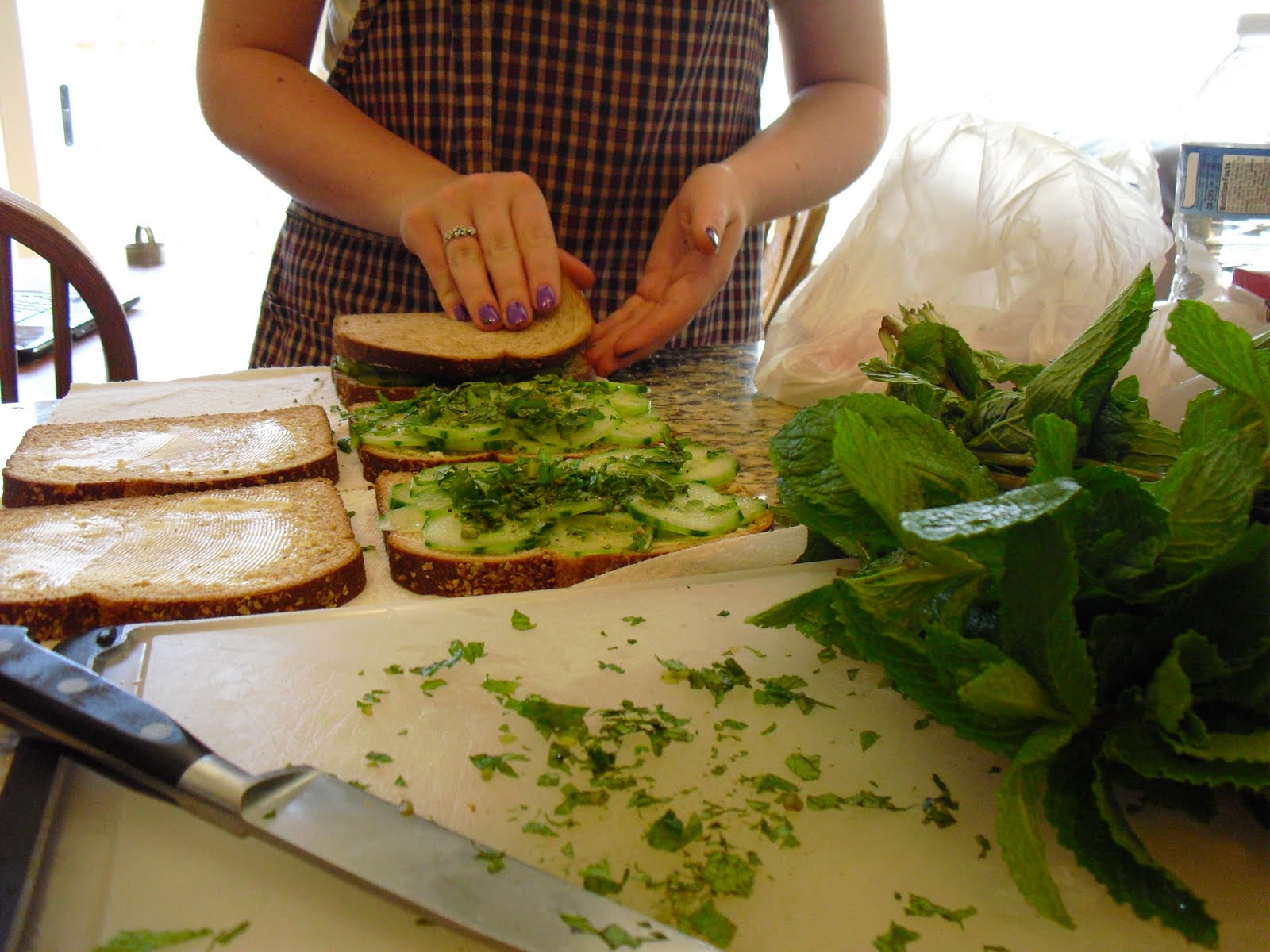
1/2-1 teaspoon finely chopped fresh mint
1/2 to taste salt and pepper
  1. Peel cucumber and slice in paper-thin rounds. Salt rounds lightly and place in colander for 15 minutes to drain. Press to release water; pat dry with paper towels.
  2. Spread sliced bread with softened butter. Put 2 layers of cucumber slices on bottom slice, sprinkle with finely chopped mint, salt and pepper to taste, and top with another buttered slice. Press lightly with palm of hand.
  3. Cut all crusts off with a sharp knife. Cut sandwiches in half diagonally and then again into quarters.
  4. Serve in alternate rows of brown and white bread sandwiches, points facing up!
Nutrition Facts: http://tinyurl.com/cucumbersandwichnutritionfacts

Drain for 15 minutes, to prevent soggy sandwiches

Mmm... Mint.

The final product.  Julie loaded on the butter, which made them delectable!
Long story short, these sandwiches are delicious!  And if I can say that as a cucumber hater, you know they’re good.  They are light and refreshing.  The mint compliments the cucumber so well, and they have just the right amount of salt to accent the flavor and provide a nice contrast to all the sweet things you typically have during teatime.  This was the only thing at our tea party, other than tea, of which I had seconds.  I know, I even surprised myself!

Fun fact about all this:  Did you know that the scene from which I quoted in The Importance of Being Earnest is what made cucumber sandwiches famous?  So the reason the Queen even serves her sandwiches at her garden party is because of Oscar Wilde!  I think it’s cool that a writer can have that much influence.  He has certainly influenced me.  I may actually start liking cucumbers, now!

By the way, are you curious about the difference between an English cucumber and a regular cucumber? 

An English cucumber is very long and thin (the one I bought was well over a foot long).  They are also softer and have fewer seeds.

Regular cucumbers are thick and short (about 5-7 inches long).  They are crispier, have more seeds, and they also have a tendency to be bitter (bleck!).

English cucumbers are more expensive (and they’re shrink wrapped!  Weird...), but there is more of it, and they taste better.  So it’s a judgment call on your part, but if you really want to be legit with your cucumber sandwiches (and you want a great taste), I recommend trying it with English cucumbers at least once.  And don't forget the fresh mint!  That's crucial!

P.S. Have you voted for your preferred Harry Potter treat in the poll on the left sidebar?  All it takes is 2 clicks!

Monday, June 27, 2011

English Tea Party: Tea Bread

I love the British.  They’re so interesting with their odd names for things.  For instance, this is called tea bread:
Not a very good shot, sorry.

...which more has the consistency of cake.  


Which is not to be confused with teacakes...


...that have the consistency of cookies.  
  

And cookies, in the UK, are called biscuits.  Whereas biscuits in America look like this:


Which are much more similar to muffins in England...

...which are nothing like our muffins. 

It’s all delightfully confusing.  And that's without bothering to bring up any mix-ups with bacon, chips, or jelly (and don’t worry, we’ll address those things in a couple of weeks). 

Of course, we can’t go getting annoyed at the British for their odd names.  After all, we named our food long after they named theirs.  And for the most part, we renamed stuff just for the sake of being different from the British.  I blame Noah Webster, who wrote the first set of American dictionaries, the most notable one published in 1828, and changed the spelling of a bunch of stuff in order to celebrate American nationalism.  It was a nice enough idea, I suppose, and it is convenient to not have to worry about superfluous U’s in words like “color” or “favorite.”  But it’s good to remember that, while some aspects of British culture seem odd to us, we were the ones who actually changed stuff.

Tangent over.  Back to tea bread.  Julie chose this recipe because it has chocolate in it.  I approved.  It was my second favorite treat we made after the teacakes.  It’s delicious, and super easy.  You should try it, too!

Conversions for weird British recipes (And I feel justified in saying "weird" since they're the ones who switched to metric on us.  We still use the English system!): 225 grams = 8 ounces = 1 cup = 16 tablespoons.  Therefore, 2 tbsp = 1 oz and 3 oz = 6 tbsp, or ¼ cup + 2 tbsp.

Follow the links for caster sugar and self-raising flour if you need substitutes for those ingredients.  For caster sugar, you have to scroll down a bit.

Marbled Chocolate Teabread
Servings: about 10 slices
225 g (8 oz) butter – 2 sticks/1 cup
225 g (8 oz) caster sugar
4 eggs, beaten
225 g (8 oz) self-raising flour
finely grated rind of 1 large orange
15 ml (1 tbsp) orange juice
few drops orange flower water (optional)
75 g (3 oz) plain chocolate
15 ml (1 tbsp) cocoa powder

  1. Grease a 900 ml (2 pint) loaf tin and line the base and sides with greaseproof paper.
  2. Cream the butter and sugar together until pale and fluffy, then gradually beat in the eggs, beating well after each addition. Fold in the flour.
  3. Transfer half of the mixture to another bowl and beat in the orange rind, juice and orange flower water, if using.
  4. Break the chocolate into pieces, put into a small bowl and place over a pan of simmering water . Stir until the chocolate melts. (Or heat up for 2o seconds in the microwave, stir, and repeat until chocolate is melted.  Careful not to burn it!)  Stir into the remaining cake mixture with the cocoa powder.
  5. Put alternate spoonfuls of the two mixtures into the prepared tin. Use a knife to swirl through the mixture to make a marbled effect, then level the surface.
  6. Bake at 180°C (350°F) mark 4 for 1 1/4 - 1 1/2 hours, until well risen and firm to the touch. Turn out on to a wire rack to cool. Serve cut in slices.

Zesting is such a pain.

Aww... I miss Julie.

Mixing chocolate into chocolate portion

Wow, my bangs were outta control.  It looks like I have a small mammal on my forehead!

Yay us!  Adding alternating spoonfuls of each portion.

Look at that beauty!

It’s so easy, and so yummy!  I love that chocolate orange flavor.  If you love that flavor combo, too, try this and let me know what you think!  You'll come to understand why Gwendolen preferred bread over cake, because this stuff is pretty darn yummy!

Thursday, June 23, 2011

English Tea Party: Teacakes

And we’re back!  Sorry you haven't had a food post from me in so long.  It’s been pretty crazy at my house with lots (anywhere between 2 and 10) of my nieces and nephews running around in the last month or so.  It was loads of fun!  But now we’re back to normal.  Time for tea! 

I don’t remember if Julie mentioned this, but we did base our tea party on a particular piece of literature.  As many of you know, tea is an essential part of English culture, so we could have pulled our recipes from just about any British book.  We focused our search to the Victorian Era of literature (during Queen Victoria’s reign, 1837-1901) and chose to settle on one of the most hilarious plays ever written, and certainly the funniest from the Victorian Era: The Importance of Being Earnest, by Oscar Wilde.

I’m sure anyone who has seen the play or movie is bouncing up and down with excitement.  If you are unfamiliar with this play, I’ll give you a quick synopsis.  Be warned – you might get a little confused.  It’s the nature of the play. (For those who have read/seen the play, you can skip this next paragraph.)

Jack Worthing lives a boring life in the country, and so pretends he has a wayward brother named Ernest, who often gets into trouble so that Jack must go to London to sort out his problems.  While in London, Jack calls himself Ernest so he can party with his good friend Algernon and court his love, Gwendolen.  Algernon, in turn, has an overpowering aunt that he likes to run away from, so he has invented a dear sickly friend named Bunbury who he must go to the country and attend to often.  One day, Algernon learns Jack’s secret that his real name is not Ernest, and also that Jack has a young and beautiful ward, named Cecily, who lives at his home in the country.  So Algernon tells everyone that he is going to visit poor sickly Bunbury, and then sneaks off to Jack’s home to meet Cecily.  There, Algernon introduces himself as Jack’s younger brother, Ernest, and he and Cecily quickly fall in love.  Chaos quickly ensues when Gwendolen comes to the country and meets Cecily, and they both profess to be in love with “Ernest.”

There’s so much more to the story.  Every line is packed with wit, and the plot is intricately woven with heavy irony.  I highly recommend watching the newer movie, which has Colin Firth as Jack, Rupert Everett as Algernon, Frances O’Connor as Gwendolen, and Reese Witherspoon as Cecily.  These actors are amazing, and they leave you howling with laughter as you watch.  It’s also fairly true to Wilde’s original script.

The following scene is my favorite part in the play, when Cecily and Gwendolen think they are both engaged to the same man, Ernest.  As such, they are very upset with each other.

Cecily: May I offer you some tea, Miss Fairfax?
Gwendolen: [with elaborate politeness] Thank you. [Aside.] Detestable girl! But I require tea!
Cecily: [Sweetly.] Sugar?
Gwendolen: [Superciliously.]  No, thank you.  Sugar is not fashionable any more. [Cecily looks angrily at her, takes up the tongs and puts four lumps of sugar in the cup.]
Cecily: [Severely] Cake or bread and butter?
Gwendolen: [In a bored manner.]  Bread and butter, please.  Cake is rarely seen at the best houses nowadays.
Cecily: [Cuts a very large slice of cake, and puts it on the tray.]  Hand that to Miss Fairfax.
[Merriman does so, and goes out with footman.  Gwendolen drinks the tea and makes a grimace.  Puts down cup at once, reaches out her hand to the bread and butter, looks at it, and finds it is cake.  Rises in indignation.]
Gwendolen: You have filled my tea with lumps of sugar and though I asked most distinctly for bread and butter, you have given me cake.  I am known for the gentleness of my disposition, and the extraordinary sweetness of my nature, but I warn you, Miss Cardew, you may go too far. (Wilde 2250-51)
Soon after this, Algernon and Jack enter to reveal that actually neither of them are called Ernest, which leads to an even bigger upset.  It’s greatness!

Okay, so you may have noticed that this scene deals with tea.  This is largely what we based our tea party menu on (although there’s another piece to this scene that I’ll address in a later post, which includes even more teatime treats).  Julie already told us about tea and butter.  Now we’re going to talk about cake, and tomorrow bread.

When we originally put this tea party together, I was searching for a teacake recipe, not a cake recipe, because “teacake” was mentioned in Jane Eyre, by Charlotte Bronte (this was before we settled on just using Importance of Being Earnest).  Teacake is different from cake – it’s more like a thick shortbread cookie.  So it doesn’t really go with what’s mentioned specifically in the scene from Earnest, but it is a classic English teatime treat.  And trust me, you do NOT want to miss out on these babies!  They were a huge hit at our little party.

English Tea Cake
(Source: AllRecipes)
Yields: 30
2 cups butter, softened
1 cup sugar
2 teaspoons vanilla extract
4 cups all-purpose flour
Optional:
Walnut halves
Nutmeg
Strawberry Jam
  1. In a large mixing bowl, cream butter and sugar. Beat in vanilla. Gradually add flour. Drop by heaping tablespoonfuls into greased muffin cups; flatten slightly. You have two options for the center:
    1. Press a walnut half into the center of each. Press down the edges with a fork.  Sprinkle a little nutmeg on top.
    2. Separate each tablespoon of dough into 1/3 and 2/3 portions.  Press the 2/3 into the bottom of the muffin tin.  Drop a teaspoon of strawberry jam onto the center.  Then take the 1/3 portion, flatten it on your palm, and poke a hole in the center of it with your finger.  Lay the 1/3 portion on top of the 2/3 portion so that the hole reveals the strawberry jam.  You can mold the dough to make the hole look nice and neat.  Press down the edges with a fork.
  2. Bake at 350 degrees F for 10-12 minutes or until edges are lightly browned. Cool for 2 minutes before removing from pans and placing onto wire racks.  Caution: Jam centers will be very hot!
Click here to view this recipe's Nutrition Facts.

Mixing dough

Julie adding walnut halves.  Don't her fingernails look fabulous?

Creating the top 1/3 for the strawberry jam teacakes

We did a half recipe, which seemed like plenty as we were baking them.  However, these little treats were the first to go!  They were absolutely delicious, and I’ve been craving them ever since.  And the great part is, they’re super easy and don’t use that many ingredients.  I highly recommend you try them, too!  Seriously, of all the sweets I’ve made for this blog, this is definitely my favorite.  I think cake is rarely seen in the best houses because it’s eaten up immediately!

Be sure to watch or read The Importance of Being Earnest!  You won’t regret it!  If you would like a little taste of what the tea scene is like acted out, click here to watch a clip from the movie (go to 8:51 to start at the beginning of the scene, 12:44 to just watch the part that I quoted).  Enjoy!

Work Cited
Wilde, Oscar. "The Importance of Being Earnest." The Norton Anthology of English Literature. Ed. Stephen Greenblatt, et al. 8th ed. New York: Norton, 2006. 2222-2263

Wednesday, May 25, 2011

English Tea Party: Pumpkin Honey Butter

Mary and I never settle for the bare minimum. We knew that butter was necessary for a tea party but did we just grab a tub of I Can't Believe it's Not Butter out of the fridge? No! Did we soften a stick of unsalted and put it on a plate? No! We MADE not one...but TWO different types of butter for this blog. You're welcome.

Pumpkin Honey Butter
(Source: Allrecipes.com)
1/2 cup softened butter
1/4 cup honey
3 tablespoons canned pure pumpkin
1 teaspoon pumpkin pie spice
1. Place the butter in a mixing bowl, and whip on high speed with an electric mixer until fluffy, about 1 minute.
2. In another bowl, stir together the honey, pumpkin, and pumpkin pie spice until well mixed. Add the honey mixture to the butter, and whip on high with the electric mixer until the mixture is fluffy and smooth, about 1 more minute. Chill the pumpkin butter for several hours or overnight to blend the flavors.
If you want, you can look at these Nutrition Facts.


Mary's KitchenAid mixer proved to be our best friend through this process. I would highly recommend one (and if anyone wants to just buy me one...that'd be cool)


We made the butters and the clotted cream the night before. Really late the night before, if I remember correctly. Here's the mixture:


Pretty color, huh? Remember how I said Mary and I never settle for the bare minimum? Yeah. We decided to make little pats of butter instead of just a amoeba-esque, ugly blob. Here's the artist hard at work!


Warning!! This recipe makes a LOT of little pats. We had PLENTY of butter and our pats were big enough for two slices of English Muffin because it's light and airy. Have a lot of people over for this tea party when you do it for yourself =)